
AI Search Is Rewriting the E‑commerce Playbook
How AI assistants are changing product discovery, compressing the funnel, and forcing e-commerce brands to rethink visibility, data, and growth.
Anna Shtovbonko
4/10/20265 min read


For years, e‑commerce growth strategies started with one assumption: shoppers begin on Google or a marketplace, type a few keywords, click through several links, and compare options themselves. That journey is breaking. Today, more and more research and discovery happens inside AI tools – and that changes how brands need to think about visibility, demand, and growth.
In this article, I’ll look at how AI is transforming search behavior, what it means specifically for e‑commerce, and what I think brands should start doing now.
From keywords to conversations
Traditional search was built on short, clunky queries: “best running shoes women,” “vitamin C serum dry skin,” “boxing gloves 12oz.” The job of SEO and performance marketing was to match those keywords, win the click, and optimize the landing page.
AI changes the front of that journey.
Instead of typing fragmented keywords, people ask full questions:
- “I run 3 times a week and have knee pain. What shoes are best for me under $120?”
- “I have sensitive, acne‑prone skin. Build me a simple skincare routine with products under $200.”
- “I need to set up a home boxing corner in my small apartment. What do I actually need to buy?”
The assistant doesn’t just show ten blue links. It gives a structured answer: key considerations, trade‑offs, and often a short list of recommended products or brands. The shopper may only click one or two links – or none at all if the AI can complete the purchase inside its own interface.
For e‑commerce, this means:
You’re no longer competing only on keywords.
You’re competing for a place inside an AI‑generated answer.
When AI becomes the new storefront
Think about how many typical e‑commerce journeys involve comparison and mental work:
Choosing between dozens of similar products.
Reading reviews to filter out low‑quality items.
Checking shipping, returns, and warranty terms.
Comparing prices and discounts across sites.
These “middle of the journey” tasks are exactly what AI is starting to take over. Instead of a shopper doing all of this manually, they can delegate it:
“Compare these three TVs and tell me which is best for a small bright living room.”
“Find me a mid‑range laptop for video editing and casual gaming, and tell me where to buy it safely.”
“I want to refresh my wardrobe for the office. Build a capsule collection with links.”
In practice, this turns AI assistants into:
A personal product researcher
A comparison engine
A shopping concierge
If the assistant can also complete checkout – or send a pre‑filled cart to a retailer – the AI becomes a kind of meta‑storefront. Brands that are visible, trustworthy, and easy to integrate will win a disproportionate share of these “delegated” purchases.
What changes for e‑commerce teams
From my perspective as an e‑commerce specialist, AI‑driven search changes several pillars of how we plan and grow.
1. Visibility moves beyond classic SEO
Ranking on page one is no longer enough if the shopper never sees the page.
You now have two visibility questions:
Can traditional search engines find and rank my pages?
Can AI systems understand, trust, and include my products in their answers?
That second part depends on how clean, structured, and unambiguous your data is: product titles, attributes, descriptions, pricing, availability, reviews, and policies. If an AI can’t confidently “read” your catalogue and your brand, it’s less likely to recommend you when it builds answers.
2. Clean product data becomes a growth lever
In most e‑commerce teams, product data quality is treated as an operational detail. In an AI‑first world, it becomes a growth driver.
Examples:
Clear, consistent attributes (size, material, use cases, fit, skin type, etc.) let AI match your products to very specific user intents.
Transparent policies (shipping times, returns, guarantees) make it easier for AI to recommend you without risk.
Well‑structured reviews and Q&A give AI context on who your product is “right for” and who it’s not.
If your catalogue is messy, incomplete, or duplicated, you’re not just hurting internal search and ads – you’re making it harder for AI agents to choose you.
3. The funnel compresses
A lot of e‑commerce conversations still focus on “AI as a tool”: better ad creatives, smarter recommendations, automated support. Those are important, but there is a bigger shift happening in how people start and complete their shopping journeys.
If more research, comparison, and even transactions move into AI experiences, the brands that are easiest for AI to understand, trust, and recommend will grow faster. The ones that ignore this will still see traffic – but not at the same quality, not at the same scale, and increasingly not from the highest‑intent buyers.
As an e‑commerce specialist, I see AI search as a new battleground for growth. It’s not just about learning a new tool. It’s about redesigning how we think about visibility, product data, and the shopper journey itself.
Why this matters now, not “later”
Here are actions I would recommend to any e‑commerce brand preparing for AI‑driven search:
1. Treat product data as a strategic asset, not a housekeeping task.
Standardize attributes, fix titles and descriptions, remove contradictions, and document policies clearly.
2. Write for humans and summarizers.
Use clear language that an AI can easily turn into bullet points: who it’s for, key benefits, limitations, and proof.
3. Make your differentiation explicit.
Don’t rely on design or “vibes” alone. Spell out what’s unique: formulation, material, fit, sustainability, warranty, or service.
4. Align SEO, performance, and product teams.
The people running search ads and content need to work closely with the people managing feeds, catalogues, and merchandising.
5. Experiment with AI on your own site.
Even a simple assistant that helps users navigate your catalogue, compare products, and answer detailed questions will teach you a lot about how people ask and what they struggle with.
Practical steps brands can take now
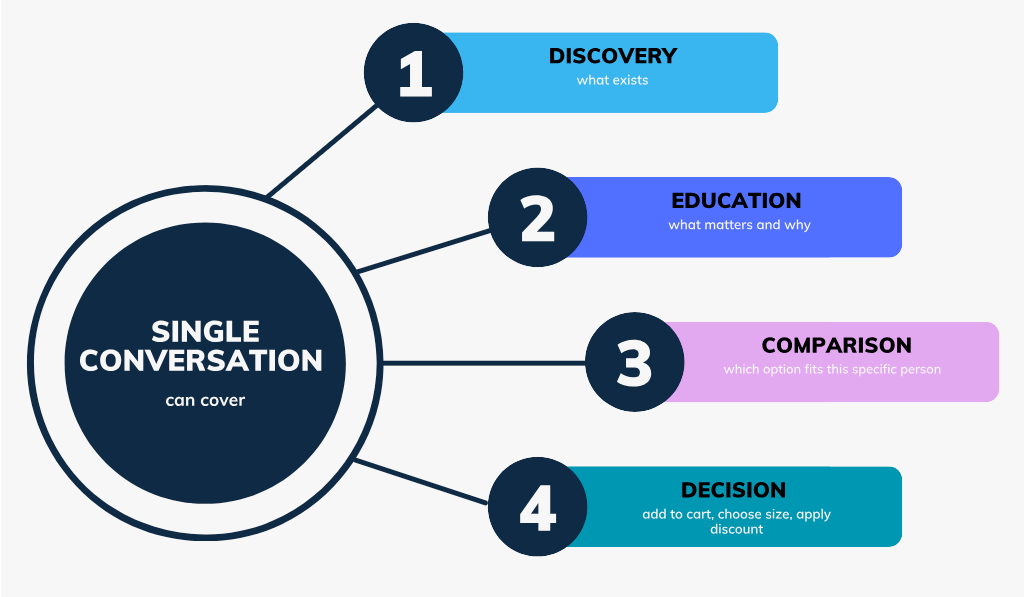
AI shrinks the distance between “I’m curious” and “I’m buying.”
A single conversation can now cover:
Discovery (what exists)
Education (what matters and why)
Comparison (which option fits this specific person)
Decision (add to cart, choose size, apply discount)
Sources
[1] Ecommerce Trends: 3 types of features ecommerce platforms are betting on in 2026 https://www.digitalcommerce360.com/2026/02/19/ecommerce-trends-retail-platform-features-2026/
[2] How Ecommerce AI is Transforming Business in 2026 - BigCommerce https://www.bigcommerce.com/articles/ecommerce/ecommerce-ai/
[3] The New E-Commerce Playbook For 2026: Trust, Profitability And AI https://www.forbes.com/councils/forbesbusinesscouncil/2026/02/18/the-new-e-commerce-playbook-for-2026-trust-profitability-and-ai/
[4] How agentic AI will reshape shopping in 2026 - eMarketer https://www.emarketer.com/content/how-agentic-ai-will-reshape-shopping-2026
[5] 3 AI Developments Impacting eCommerce and SEO in 2026 | Amsive https://www.amsive.com/insights/seo/3-ai-developments-impacting-ecommerce-and-seo-in-2026/
[6] What to expect in digital advertising and commerce in 2026 https://blog.google/products/ads-commerce/digital-advertising-commerce-2026/
[7] AI becomes central battleground among ecommerce leaders https://www.digitalcommerce360.com/2026/01/27/ai-executives-leaders-ai-battleground/
[8] How Brands Can Adapt When AI Agents Do the Shopping https://hbr.org/2026/02/how-brands-can-adapt-when-ai-agents-do-the-shopping
[9] AI in Retail & E-commerce: Transforming Operations in 2026 https://katalysttech.com/blog/how-is-ai-revolutionizing-retail-and-e-commerce-operations-in-2026/
[10] Forbes: How AI And Culture Will Redefine E-Commerce In 2026 https://www.8451.com/knowledge-hub/media/forbes-how-ai-and-culture-will-redefine-e-commerce-in-2026/Write your text here...
This is great for conversion rates, but it also means you have fewer chances to “convince” the shopper along the way. Your brand story, value, and differentiation have to be extremely clear and easy to summarize. If an AI can’t explain why someone should pick you in one or two sentences, that’s a risk.